
A nightclub app simplifying planning coordination for busy adults.
Role
UX/UI Design
Information Architecture
Scope
6 Weeks
Tools
Figma
Canva

With the constant hustle of busy adult life, coordinating clubbing plans becomes a daunting task. Existing apps fall short in providing efficient solutions for this challenge. Recognizing this gap, our project aims to develop an app for a (hypothetical) nightclub based in Singapore, that simplifies the planning process and enhances the overall user experience.

The Quest for Common Ground
Picture this: it's Friday evening, and you and your buddies are ready to unwind after a tough week at work. Messages dominate the group chat. However, as the conversation progresses, it becomes clear that deciding on a time and place is not an easy task.
Conflicting schedules, last-minute work tasks, family obligations, and sheer tiredness all present obstacles, transforming what should be a simple plan into a logistical problem, leaving you feeling frustrated and disheartened.
This common scenario highlights the challenge many adults face when trying to organize a night out with friends. The need for a solution that simplifies the planning process and accommodates everyone's needs is increasingly apparent.
Navigating the Maze of Social Scheduling
My goal is to create an app design (concept) for the Singapore based - Reverie nightclub to simplify planning and managing guest lists with an easy-to-use interface. It will allow groups to quickly make decisions, handle last-minute changes, and ensure a smooth night out experience.
Target Audience
Age Group:
18-45 years old
Financial Status:
$$ - $$$
Work Profile:
Students & working professionals
Competitive Analysis


To assess existing club offerings and integrate areas for improvement into Reverie's app design, I analyzed the mobile websites of three prominent clubs in Singapore.
Talking to Some Users
User research is essential for understanding user needs and behaviors. To do this well, I conducted a contextual inquiry and user interviews with some friends and peers to gain insights into the challenges young individuals with busy lives face when planning social outings, particularly nightclub visits.
Contextual Inquiry
I carried out 2 contextual inquiries with to identify both the logistical obstacles and emotional challenges that arise during the event planning process.


User Interviews
In addition to the contextual inquiry, I interviewed some young individuals like Anmol, Wentao, and Meghna to explore their experiences and preferences related to clubbing through structured questions.
Questions
-
How do you feel about coordinating plans with friends?
-
Do you attend nightclubs? If not, what's the reason?
-
What aspects of current nightclub apps do you dislike?
-
Would you use an online platform to plan a night out with friends?
Interview Insights:
-
Anmol finds it hard to plan due to conflicting schedules and booking being a hassle.
-
Wentao is annoyed by last-minute cancellations and worries about money because apps don't offer refunds.
-
He also wishes for translation features when traveling.
-
Meghna feels pressure to make excuses to avoid going out and struggles with social obligations.
-
She doesn't have time to accommodate for each friend individually and wants an easier way to organise clubbing plans.
Pain Points
-
Time constraints hinder users from clubbing.
-
Accessibility challenges are present for users while travelling.
-
Booking processes are complex and time-consuming.
-
Lack of refunds in clubs poses financial risk for users.
-
Navigating social obligations can be anxiety inducing.

After the user research, I proceeded to create an affinity map to better understand user pain points and see what factors are common and themes that follow.
I organized these issues into categories such as "Events," "Booking," and "Language & Accessibility."


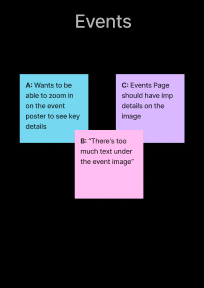


Affinity Diagram
Redefining the Problem
Planning a night out with friends has become increasingly difficult amidst busy adult schedules. Juggling conflicting plans, dealing with sudden cancellations, and struggling through complicated booking processes make the whole experience frustrating. Additionally, the lack of refund options in clubs can lead to financial worries. These issues make it hard for people to enjoy going out, calling for a simpler solution that works for everyone.
How Might We... streamline the nightclub planning experience for busy adults, addressing scheduling conflicts, last-minute changes, and accessibility concerns?
Putting On My Thinking Cap...
My approach to addressing the pain points involved careful analysis and creative ideation to develop a solution that would truly set Reverie apart from existing nightclub apps. While the existing apps offered booking processes, I realized that simply refining the form wouldn't sufficiently address the issue of scheduling conflicts. I needed to create something unique that would both solidify plans and maintain flexibility.
After exploring multiple concepts, I came up with an invites system to streamline the planning process. This feature simplifies securing spots at events or on the guestlist by leveraging contact syncing and personalized notifications. Users can effortlessly invite friends and receive real-time RSVP updates, allowing them to focus on other tasks without the hassle of coordinating schedules via lengthy chat threads.
Moreover, by removing the need for detailed explanations, the system reduces social anxiety for those declining invitations.
Importantly, the system offers dynamic cost calculations as RSVPs change, giving users clarity on payment arrangements. Furthermore, the flexibility to edit bookings up to 3 hours before the event and defer final charges until entry minimizes financial risks, providing users with peace of mind and greater control over their spending.
Wireframes


How Well Does It Work?
After creating wireframes, I conducted a usability study to identify challenges users faced with the app's structure and gather insights into early-stage user experiences. Through observing interactions and collecting feedback, I gained valuable insights for refining the design before advancing to mockups.

The Feedback Loop: Iterative Improvements
1. Lack of Escape Hatches: Users couldn't backtrack easily, causing frustration.
Solution: Introduced a navigation system for easy backtracking, enhancing user control.
2. Ambiguous Button Labels: Confusing labels led to uncertainty.
Solution: Clarified labels and added visual indicators for confirmation.
3. Limited Payment Options: Users wanted more payment flexibility.
Solution: Added options for individual or group payments, improving user experience.

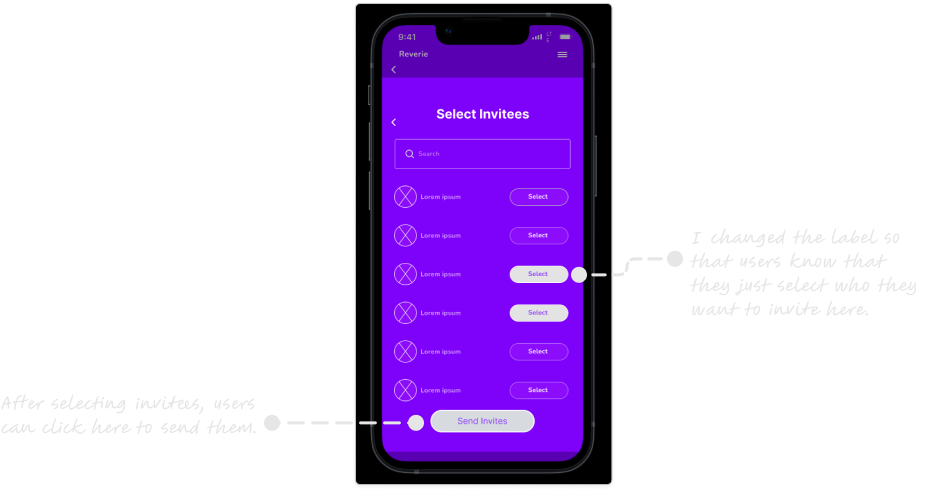


The Final Mockups
Following the usability test, I iteratively refined the wireframes and prototype based on user feedback. Once confident in meeting user needs, I transitioned to the visual design phase. Inspired by psychedelic imagery, I focused on selecting a cohesive color palette and imagery to establish a consistent look and feel, ensuring alignment with user feedback and requirements.
Vibrant colors were strategically used to create a modern, energetic vibe, while maintaining an intuitive layout for key elements, resulting in visually appealing screens that effectively showcase all relevant information.
User Person

Based on interviews and affinity diagrams, I developed persona names Sara.
She is an exchange student with a busy schedule who desires to socialise with friends but struggles to find time for planning.
She wants to explore the clubs but encounters language barriers on the apps

Next Steps For Reverie...
The next step for Reverie is to conduct additional usability studies for further improvement based on user feedback. I envision expanding the app's features to include functionalities like "Find My Friends" for easy navigation within the club and integrated food and drink ordering.
I'm eager to refine the app's interface, especially the notification screens, to ensure a seamless user experience. With continuous innovation, Reverie has the potential to revolutionize the nightclub scene, not only as a well-designed product for users but also as a viable business venture.
Challenges Faced
Solution Complexity:
Striking a balance between feature-rich functionality and user-friendly simplicity proved challenging, necessitating meticulous design considerations.
Handling Scheduling:
Devising a concept that effectively manages scheduling conflicts and accommodates last-minute cancellations posed significant hurdles during the ideation phase.
Flexibility vs. Streamlining:
Finding the right equilibrium between providing flexibility in the planning process and maintaining a streamlined user experience presented a delicate balancing act.
Accessibility Integration:
Integrating accessibility features, such as voiceover support and language translation, demanded thorough planning to seamlessly incorporate them into the app interface.
Aesthetic Direction:
Navigating aesthetic complexities, particularly in selecting a vibrant color palette, while ensuring the final design fosters an inviting and dynamic user experience for all users.
My Learnings
User-Centric Design:
Understanding user needs is pivotal for designing effective solutions.
Balancing Complexity:
Striking a balance between functionality and usability is crucial.
Iterative Design Process:
Iterative testing and feedback are essential for refining user experience.
Accessibility Integration:
Inclusivity in design enhances the overall user experience.
Continuous Improvement:
Embracing innovation and adaptation ensures the ongoing relevance and competitiveness of the product.
Recognizing that no project is flawless, I continually seek opportunities for improvement and strive to enhance my skills and approach with each iteration.
Reflection
Throughout the app's development, I aimed to create an app that alleviates the struggles of organizing an evening out, particularly for young adults like myself. It was a challenging yet enriching process, offering valuable insights into UX design and emphasizing continuous learning. Reflecting on this journey, I'm proud to have overcome challenges and crafted a design concept that meets user needs.
Thank You!
